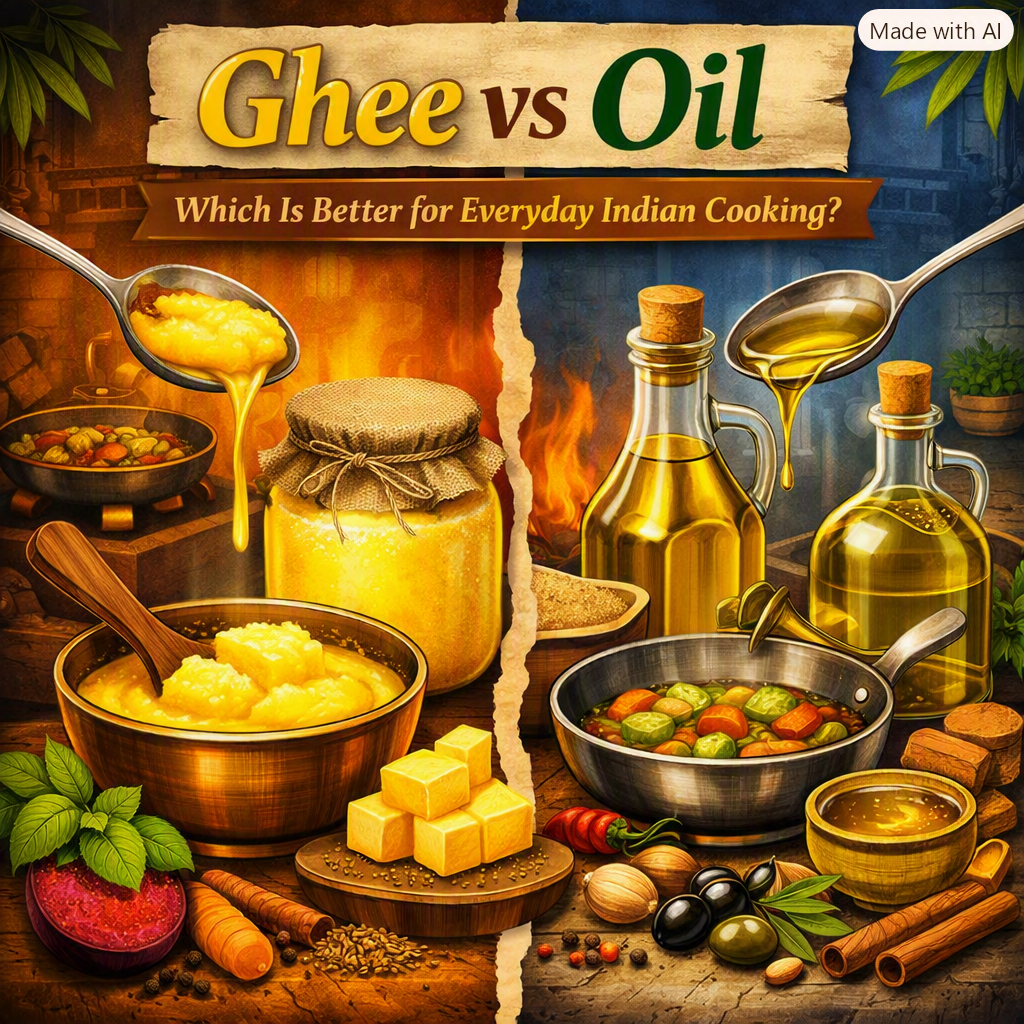
Choosing the right cooking fat is an important part of a healthy Indian kitchen. From tadka and parathas to sabzi, dal and fried snacks, both ghee and cooking oils have a regular place in Indian meals. But when it comes to Ghee vs Oil, many people wonder which option is healthier and better for everyday cooking.
The truth is that neither ghee nor oil is automatically “best” for every dish or every person. The better choice depends on the type of oil, cooking method, quantity used and your overall diet. In this guide, we will compare ghee and oil, discuss their nutritional benefits, explain how to choose the Best Cooking Oil, and look at the potential Desi Ghee Benefits of including ghee in a balanced diet.
Ghee is a traditional Indian clarified butter made by heating butter and separating the milk solids from the fat. It has a rich aroma, nutty flavour and is widely used in Indian cooking and traditional food practices.
Cooking oil, on the other hand, is extracted from various plant sources such as mustard seeds, groundnuts, sunflower seeds, sesame seeds, rice bran and olives.
Different oils have different fatty-acid profiles and cooking properties.
The biggest difference between ghee and oil is their source and composition. Ghee is an animal-derived fat, while most common cooking oils are plant-based. Both are
calorie-dense, so portion size matters regardless of which one you choose.
Both ghee and oil mainly provide dietary fat and calories. However, their fat composition can vary considerably.
Ghee contains a high proportion of saturated fat along with monounsaturated and other fatty acids. It also contains small amounts of fat-soluble vitamins, depending on the source and preparation.
Plant-based oils can contain varying amounts of monounsaturated and polyunsaturated fats. For example, mustard, groundnut, sesame, rice bran and olive oils have different nutritional profiles.
This is why simply asking whether ghee or oil is healthier can be misleading. The more useful question is: Which fat is appropriate for this cooking method, in what quantity, and as part of what overall diet?
Desi ghee has been a traditional ingredient in Indian households for generations. When consumed in moderation, it can be part of a balanced diet.
Ghee is energy-dense and can contribute calories to meals. This can be useful when used appropriately as part of an overall balanced eating pattern.
Ghee can contain fat-soluble vitamins such as vitamins A, D, E and K, although the amounts vary depending on the production process and source.
One of the biggest advantages of ghee is its distinctive aroma and flavour. A small amount can add richness to dal, khichdi, roti, rice and vegetables.
Ghee works particularly well in dishes where its flavour is an important part of the recipe. It is commonly used for tadka, roasting, sweets and festive preparations.
Ghee has a relatively high smoke point, making it suitable for several cooking techniques when used correctly. However, repeatedly overheating any fat should be avoided.
Cooking oils also have an important place in a balanced Indian kitchen. Their nutritional value depends heavily on the oil you select.
Different plant oils provide different combinations of monounsaturated and polyunsaturated fats. Choosing a suitable oil can help add variety to your dietary fat intake.
Oil can be used for sautéing, stir-frying, shallow frying, deep frying and other cooking methods, depending on the specific oil and its heat stability.
Mustard oil can complement many North and East Indian recipes, while groundnut oil works well for frying and everyday cooking. Sesame oil is popular in several regional cuisines, and olive oil is often used for dressings and selected cooking applications.
Because cooking oil is liquid, it can be measured relatively easily. Using a spoon instead of pouring directly from the bottle can help control the amount added to food.
There is no single Best Cooking Oil for everyone. Instead, consider these factors:
1. Cooking temperature: Choose an oil appropriate for the cooking method and avoid repeatedly heating the same oil.
2. Fatty-acid profile: Look at the overall nutritional composition rather than choosing an oil only because of its marketing claims.
3. Refinement and processing: Consider the type of processing and choose products from reliable manufacturers.
4. Variety: Rotating or using different suitable oils can provide variety in your dietary fat sources.
5. Quantity: Even a nutritious oil can contribute excessive calories when used in large amounts.
The best choice can depend on what you are cooking.
For dal and khichdi, a small spoonful of ghee can provide a delicious finishing touch. For vegetable stir-fries and sabzis, a suitable cooking oil can work well.
For parathas, both ghee and oil can be used depending on your preference. Ghee provides a richer taste, while oil offers a lighter alternative depending on the quantity used.
For deep frying, choose an oil that is appropriate for high-temperature cooking and avoid reusing oil repeatedly.
For traditional sweets, ghee is often preferred because its aroma and richness contribute significantly to the final taste.
This is one of the most common questions about Ghee vs Oil, but there is no universal answer.
Ghee is not a “free food” simply because it is traditional, and vegetable oil is not automatically healthy simply because it comes from plants. Both are calorie-dense fats.
For people who need to manage their saturated-fat intake, the amount of ghee they consume may be particularly important. Likewise, choosing highly processed or repeatedly heated oils is not a good everyday strategy.
The key is balance. Use reasonable quantities, choose quality fats, eat plenty of vegetables, whole grains, pulses and other nutrient-rich foods, and avoid relying heavily on fried foods.
Yes. Many Indian households naturally use both.
You might use cooking oil for preparing a vegetable dish and add a small amount of ghee to dal or rice for flavour. There is no requirement to choose only one fat for your entire kitchen.
Using both can also allow you to match the fat to the recipe. The goal should not be to completely eliminate one category but to make sensible choices based on your dietary needs and cooking habits.
Portion control is more important than simply choosing ghee or oil.
A common mistake is adding generous amounts of oil or ghee because they improve taste. However, fats are calorie-dense, so frequent heavy use can increase overall calorie intake.
Instead, measure the amount you use and focus on flavour-enhancing techniques such as spices, herbs, ginger, garlic, lemon and fresh vegetables.
If you have high cholesterol, cardiovascular disease, diabetes or another condition requiring specific dietary restrictions, it is sensible to discuss your fat intake with a qualified healthcare professional.
So, Ghee vs Oil—which is better for everyday Indian cooking?
The answer is: both can have a place in a balanced diet.
Ghee is excellent when you want traditional flavour, richness and a small amount of fat for finishing dishes. Cooking oils provide variety and can be practical for everyday sautéing and other cooking methods.
Rather than searching for one “perfect” fat, focus on choosing appropriate oils, using ghee in moderation, avoiding repeatedly heated fats and maintaining variety in your overall diet.
The debate between ghee and oil does not need to be an either-or decision. Desi Ghee Benefits and the nutritional advantages of suitable plant-based oils can both be considered when planning a balanced Indian diet.
When choosing the Best Cooking Oil, look at its nutritional profile, cooking suitability, quality and how much you actually use. Similarly, enjoy ghee for its flavour and traditional role while keeping portions sensible.
Ultimately, healthy cooking is not just about one ingredient. It is about the complete meal, cooking method, portion size and your overall eating pattern. Use ghee and oil thoughtfully, enjoy a variety of nutritious foods, and make choices that fit your individual dietary needs.

Discover how **Room Sprays** can refresh your home with pleasant and inviting fragrances. Learn about the benefits, popular scents, everyday uses, and tips for choosing the **Best Room Sprays** for different spaces. From floral and citrus to woody and herbal fragrances, find out how a **Room Freshener Spray** can enhance your indoor atmosphere. Explore simple ways to choose and use room sprays for a fresher, more comfortable home.

Reed diffusers are a simple and stylish way to keep your home smelling fresh without flames or electricity. This guide explains how reed diffusers work, their benefits, popular fragrance options, and how to choose the right one for different rooms. Learn about fragrance strength, reed types, placement, and maintenance to get longer-lasting results. Whether you want a relaxing bedroom scent or a refreshing fragrance for your living room, discover how to choose the best reed diffusers for home.

Discover the world of **Scented Candles** and learn about their different types, benefits, popular fragrances, and how to choose the right one for your space. From floral, fruity, vanilla, and woody scents to soy wax and decorative options, this guide explores the choices available for every mood and occasion. Learn how **Scented Candles for Home** can enhance décor, create a relaxing atmosphere, and add warmth to everyday moments. Find helpful tips for choosing the **Best Scented Candles** based on fragrance, wax type, size, room, and personal preference, along with essential candle safety tips for a better experience.


